Why Choose Licensed Electricians Through 602 Electric?
Arizona law requires electrical contractors to hold an active C-11 license issued by the Registrar of Contractors (ROC) for any project exceeding $1,000.[2] That license isn't cosmetic. It confirms the contractor has passed technical exams, proven financial responsibility through a minimum $7,500 bond, and secured liability insurance that protects you if something goes wrong.[2]
You can verify their credentials in real time at roc.az.gov before signing a single estimate.[1]
Unlicensed contracting is common in Phoenix. Contractors operating below the legal threshold or ignoring it entirely. Arizona prosecutes unlicensed work with penalties up to $10,000 per violation and potential criminal charges.[6] If an unlicensed contractor cuts corners, skips inspections, or disappears mid-project, you have limited recourse.
A licensed contractor operates under ROC oversight and carries workers' compensation insurance if they employ anyone, protecting you from liability if someone gets hurt on your property.[3]
This directory surfaces contractors who show up within a guaranteed 2-hour window, provide free upfront quotes, and explain the scope before starting work. You're not gambling on a name pulled from a search ad. You're comparing pros who have already cleared Arizona's regulatory bar.
| Licensed Contractor | Unlicensed Contractor |
|---|---|
| ROC-verified credentials | No state oversight |
| $7,500+ bond protecting homeowners | No financial guarantee |
| Liability & workers' comp insurance | You assume liability risk |
| Permit-compliant work | Often skips permits |
| Legal recourse through ROC | Limited options if issues arise |
Common Residential Electrical Services in Phoenix
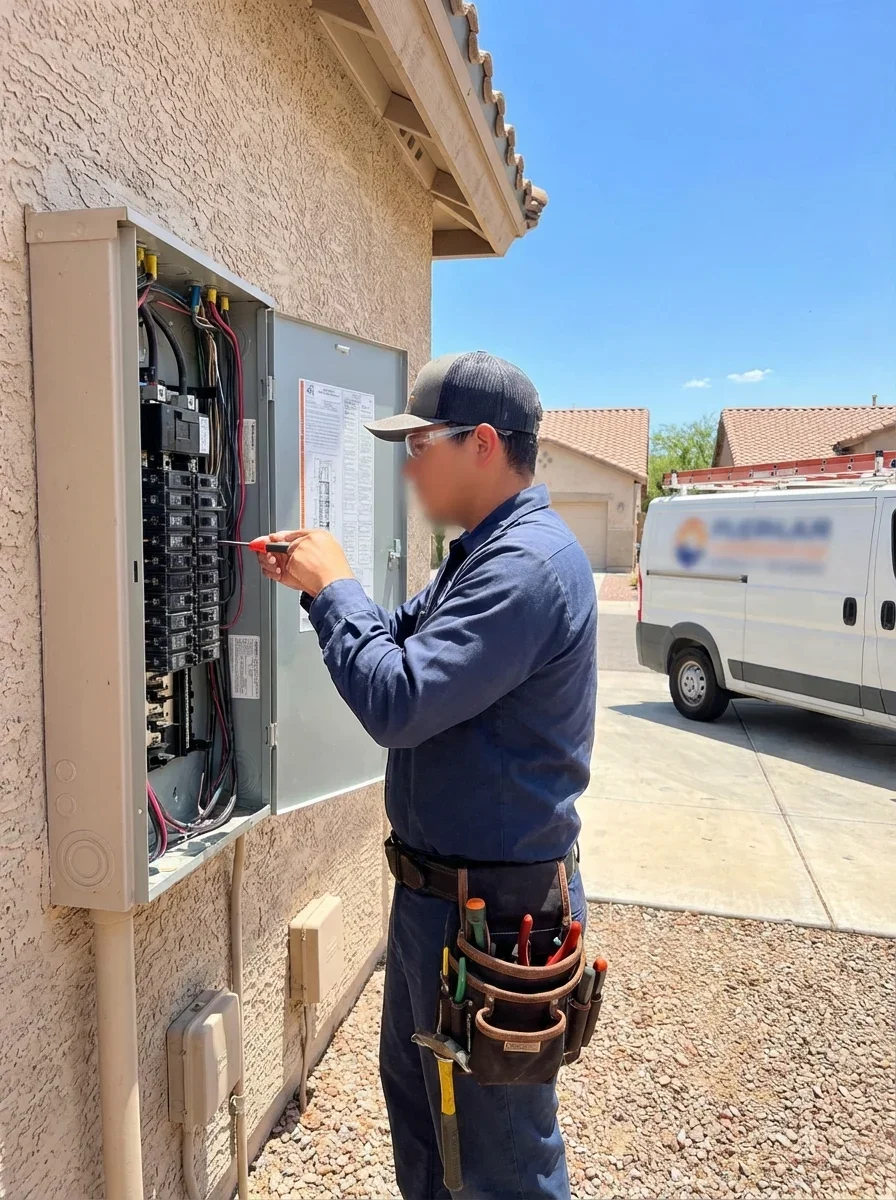
Phoenix homes built before 2000 were designed for electrical loads that no longer reflect how you live. Adding a second AC unit, a Level 2 EV charger, or converting a garage into a home office often means your existing panel can't deliver the amperage those systems demand.
The services below represent the most frequent projects homeowners request. Understanding what each involves helps you evaluate whether a quote reflects the real scope.
Panel Upgrades and Service Replacements
Your electrical panel is rated for a specific amperage: typically 100, 150, or 200 amps. If you're tripping breakers when the AC and dryer run simultaneously, or if you're planning to install an EV charger that draws 40-50 amps, your panel may be undersized.
Panel upgrades in Phoenix require permits and coordination with APS or SRP to upgrade the utility's service drop.[4] The city's Planning & Development Department reviews plans to ensure compliance with the 2020 National Electrical Code (NEC) as adopted locally.[5]
A 100-to-200-amp upgrade typically runs $1,800 to $3,500. The final cost depends on whether the meter base needs replacement and how far the panel sits from the utility connection. Some older homes still use Federal Pacific or Zinsco panels, which fail inspections due to known fire risks.
If your inspector flags one of those brands, replacement isn't optional.
Whole-Home Rewiring and Circuit Installation
Homes built in the 1960s and 1970s often have aluminum branch wiring, which expands and contracts at different rates than copper, loosening connections over time and creating arc points. If you're buying a home with aluminum wiring, expect lenders and insurers to require remediation or full replacement before closing.
Whole-home rewiring in a 1,500-square-foot ranch costs $8,000 to $15,000. That factors in drywall access, fishing new wire through stud bays, and patching walls post-installation. You'll find more detail on this specific issue in our aluminum wiring replacement guide.
Phoenix's slab-on-grade construction complicates rewiring in ways that don't affect homes with basements. If your circuit runs are embedded in the slab, rerouting may require attic runs or surface-mounted conduit. Contractors who specialize in Arizona construction understand these trade-offs and present options that minimize drywall damage.
EV Charging Station Installation
Level 2 EV chargers draw 30 to 50 amps continuously. Most garage circuits were designed for a maximum of 20 amps.
Installing a charger means running a new dedicated circuit from your panel to the garage, mounting the unit, and pulling a permit through the city.[4] Costs range from $800 for a simple 20-foot run to $2,500 if the panel sits on the opposite side of the house and requires conduit runs through exterior walls.
Some electricians include the charger hardware in their quote. Others bill labor separately and let you supply the unit. Clarify that upfront. If your utility offers rebates for EV charger installation (both APS and SRP have programs that shift depending on the year), your electrician should know the application process and what documentation the utility requires.
Our EV charger installation guide walks through rebate eligibility and what to expect during permitting.
How to Verify Electrician Credentials in Arizona
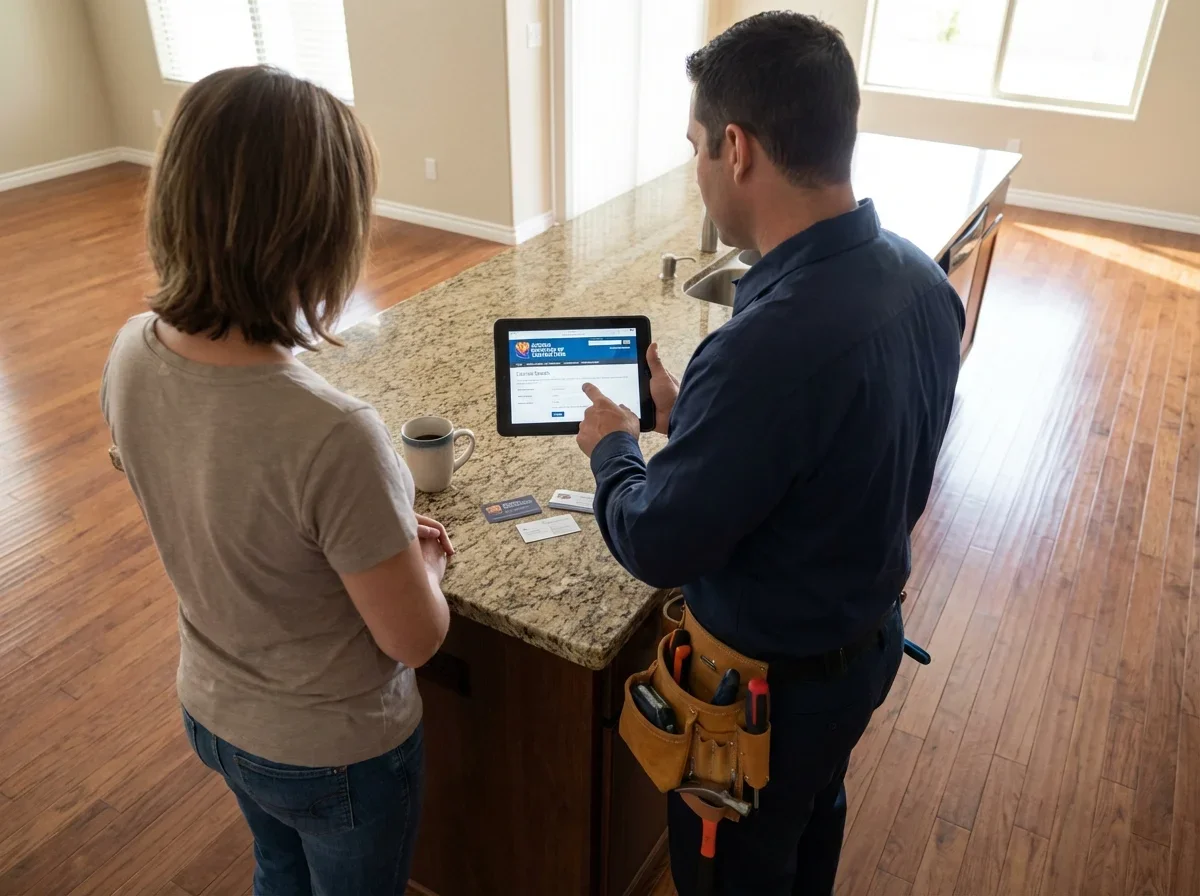
The ROC's online license lookup at roc.az.gov is the first step before you accept any estimate.[1] Enter the contractor's name or license number, and you'll see their license status (active, expired, or suspended), classification (C-11 for electrical work), bond amount, and insurance details.
If the license shows "expired" or "revoked," walk away. If the listing notes disciplinary action or complaints, read the case summaries before proceeding.
Beyond the license, confirm the contractor carries general liability insurance and, if they employ anyone, workers' compensation coverage. Arizona doesn't mandate workers' comp for contractors without employees, which creates a gap: if a sole proprietor gets injured on your property, you could face liability unless you verify coverage in advance.[3]
Ask for a certificate of insurance (COI) naming you as an additional insured for the project duration. Legitimate contractors provide this without hesitation.
Some electricians operate under a "dual license" (residential and commercial), while others hold a residential-only ROC license. For standard home projects, residential classification is sufficient. If you're wiring a detached ADU with a separate service or installing a commercial-grade backup generator, confirm the contractor holds the appropriate commercial classification.
The ROC bond for a specialty dual license starts at $7,500, but that bond doesn't cover damages from poor workmanship. It's designed to address licensing violations and unpaid subcontractors.[2] You still need insurance to protect against property damage or injury claims.
What to Check Before Hiring:
- Active C-11 license status at roc.az.gov
- General liability insurance (minimum $1M recommended)
- Workers' compensation coverage if contractor has employees
- Certificate of insurance (COI) naming you as additional insured
- No active disciplinary actions or unresolved complaints
- Appropriate license classification (residential vs. dual)
What Should Electrical Services Cost in Phoenix?
Hourly rates for licensed electricians in the Phoenix metro range from $75 to $225. Final cost depends on the contractor's experience, whether you're scheduling routine service or an emergency call, and the complexity of the job.
A service call for troubleshooting a tripped breaker might take 30 minutes and cost $150 including the diagnostic fee. A full kitchen remodel with new circuits, outlets, and under-cabinet lighting could run $3,000 to $6,000 depending on how many appliances require dedicated lines.
Panel upgrades typically fall between $1,800 and $3,500 for a standard 200-amp replacement. Whole-home rewiring ranges from $8,000 to $15,000 for a single-story home under 2,000 square feet. EV charger installations average $1,200 to $2,000 when the panel is close to the garage and has available capacity.
If the panel needs an upgrade before the charger installation, add the panel cost to the charger quote.
Permit fees in Phoenix vary by project scope but generally run $50 to $150 for residential electrical work.[4] Some contractors include permit costs in their flat-rate quotes. Others bill them separately. Ask before signing. Inspections follow once the work is complete, and if the installation fails inspection due to code violations, you'll pay for the contractor's time to correct the issues and schedule a re-inspection.
One pattern homeowners miss: contractors who quote suspiciously low often skip permits or use substandard materials. Cash-only deals with no receipt are a red flag under Arizona law, as they often signal unlicensed work designed to evade ROC oversight.[6]
You save $200 upfront and risk thousands in re-work when an inspector flags the unpermitted installation during a future home sale.
Questions to Ask Before Hiring an Electrician
Start with license verification, but don't stop there. Ask whether the contractor pulls permits for the proposed work, and confirm they'll schedule the required inspections. If they tell you "permits aren't necessary for this job," cross-check with the city's permit requirements.
Phoenix mandates permits for panel upgrades, service changes, rewiring, and EV charger installations. Anything that alters your home's electrical capacity or involves new circuits.[5]
Request a written estimate that itemizes labor, materials, permit fees, and any subcontractor costs. Vague quotes ("around $2,000") leave room for surprise charges once the project starts. A detailed proposal specifies exactly what you're paying for and provides a baseline if disputes arise.
Ask how the contractor handles unforeseen conditions. If they open a wall and discover knob-and-tube wiring that wasn't visible during the initial assessment, what's the change order process?
Confirm the warranty on both labor and materials. Reputable contractors guarantee their work for at least one year, and manufacturers typically cover equipment (panels, breakers, fixtures) separately. If a breaker fails six months after installation, who pays for the replacement and the service call?
Get that in writing.
Ask about arrival windows and project timelines. Some contractors schedule within a guaranteed 2-hour window, minimizing the half-day you'd otherwise spend waiting. For larger projects like whole-home rewiring, ask for a realistic completion timeline and whether the contractor anticipates any permitting delays. Phoenix's Development Services Department typically reviews residential electrical permits within 3 to 5 business days, but complex plans or incomplete submissions extend that window.[5]
Pro Tip: A written estimate protects both parties. If a contractor discovers knob-and-tube wiring or undersized conduit mid-project, a detailed change order process prevents disputes about additional costs. Verbal agreements evaporate when the final bill arrives—insist on documentation at every stage.
Browse Qualified Electricians by Service Type
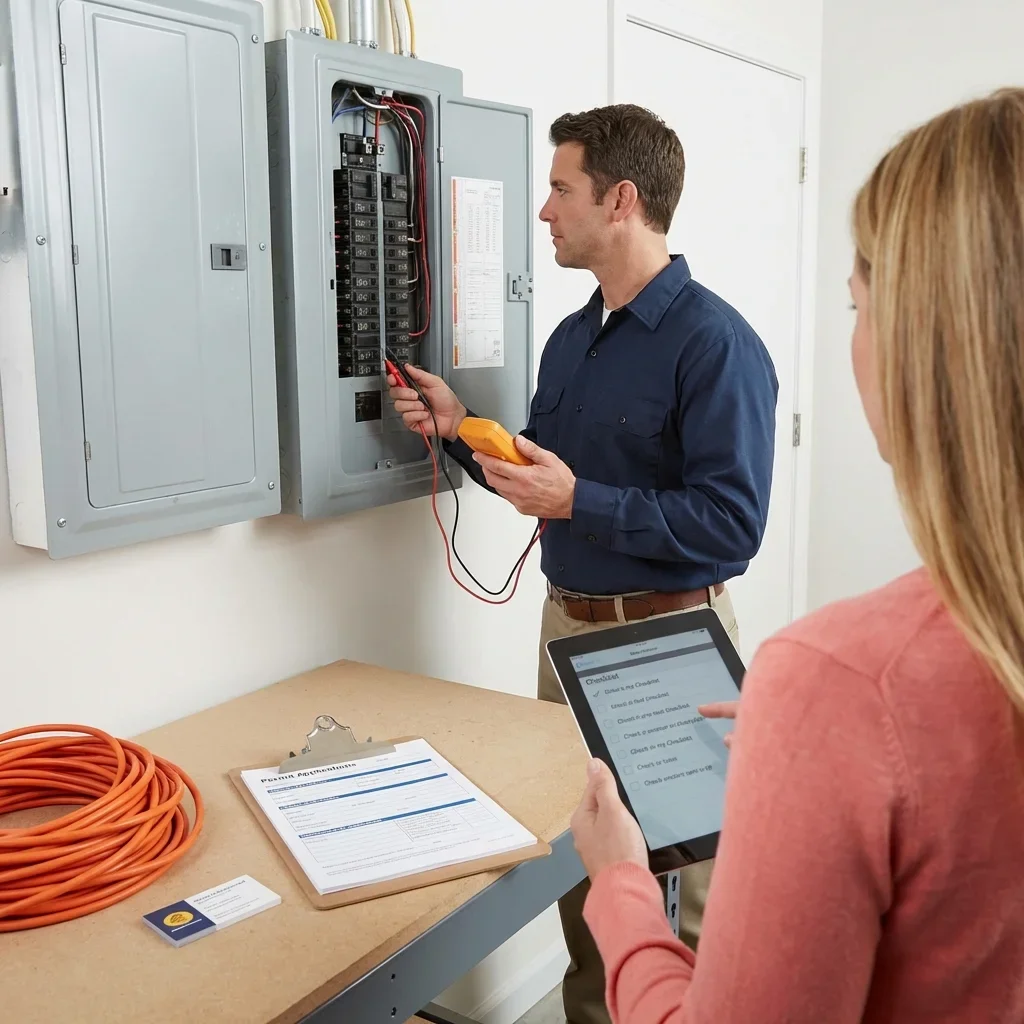
The contractors listed in this directory specialize in different areas of residential electrical work. If you need a pool pump wired for a new installation, you'll want someone experienced with pool and spa electrical systems who understands Arizona's specific bonding and grounding requirements around water.
If your home office requires dedicated circuits for servers and monitors, look for contractors who handle dedicated circuit installations and can calculate the load requirements for your equipment.
Older homes often benefit from whole house rewiring when multiple circuits show signs of wear or when insurance companies flag outdated wiring during underwriting. Homes in lightning-prone areas of the metro (particularly elevated properties in north Scottsdale or higher terrain near South Mountain) may justify lightning protection installation to safeguard panels and sensitive electronics.
For homes with aluminum wiring, our aluminum wiring replacement service page explains remediation options and connects you with contractors who specialize in COPALUM crimping or AlumiConn connectors, both approved methods under current code. If you're preparing to sell and need documentation of electrical safety for buyers, the electrical wiring inspection and certification service provides third-party verification that your system meets code.
Emergency calls require immediate response. A burning smell from an outlet, a panel that's hot to the touch, or a complete loss of power in part of your home. The emergency electrical service listings include contractors who offer 24/7 availability and prioritize same-day dispatch for safety hazards.
Understanding what constitutes an actual emergency versus a project that can wait until morning helps you avoid inflated after-hours rates for non-urgent issues. Our emergency electrical services guide breaks down what qualifies and what doesn't.
- Arizona Registrar of Contractors. "Arizona Registrar of Contractors License Search." https://roc.az.gov/license-lookup. Accessed April 06, 2026.
- Arizona Registrar of Contractors. "Electrical Contractor License (C-11)." https://roc.az.gov/license-classifications/c-11-electrical-contractor. Accessed April 06, 2026.
- Arizona Industrial Commission. "Workers' Compensation Insurance Requirements." https://www.azica.gov/WC/employer-information/who-must-have-workers-compensation-insurance. Accessed April 06, 2026.
- City of Phoenix Planning & Development Department. "Electrical Permits." https://www.phoenix.gov/pdd/permits/electrical-permits.html. Accessed April 06, 2026.
- City of Phoenix Development Services Department. "Building Code & Permits - Electrical Work." https://dsd.phoenix.gov/permits/building-code-permits/electrical. Accessed April 06, 2026.
- Arizona Registrar of Contractors. "AZ ROC Unlicensed Contracting Information." https://roc.az.gov/unlicensed-contracting. Accessed April 06, 2026.