What the ROC C-11 Commercial Electrical License Covers
The C-11 license authorizes installation, repair, and maintenance of electrical wiring, apparatus, and equipment using energy less than 600 volts in commercial structures.[2] That includes office buildings, retail spaces, warehouses, restaurants, medical facilities, and multi-family complexes.
Scope includes branch circuits, feeders, service panels, disconnects, lighting systems, receptacles, and low-voltage control wiring for HVAC, security, and fire alarm integration. Work on systems over 600 volts falls under separate classifications. If your project involves a 480V three-phase system common in larger commercial buildings, verify the contractor holds the appropriate high-voltage endorsement.
What C-11 Doesn't Cover
C-11 contractors cannot perform residential electrical work under the same license. Arizona maintains strict separation between residential (R-series) and commercial/general (B/C-series) classifications.[5]
A contractor with only a C-11 license working on a single-family home or duplex is operating outside their classification. That matters when something goes wrong. Your insurance may deny coverage for work performed by an improperly licensed contractor.
C-11 also doesn't authorize low-voltage work below 50 volts (like structured cabling or A/V systems) unless it's incidental to higher-voltage electrical installations. Dedicated data cabling or security system wiring typically requires separate credentials or falls under unlicensed work depending on contract value.
Quick Reference: C-11 vs R-11 License Distinctions
- C-11 covers: Commercial buildings, multi-family (3+ units), retail, office, industrial
- R-11 covers: Single-family homes, duplexes, townhomes
- Voltage limit: Both limited to systems under 600 volts
- Cannot cross-license: C-11 contractors cannot work on residential properties under the same license
- Insurance risk: Wrong license classification may void coverage claims
Experience and Exam Requirements for C-11 Licensure
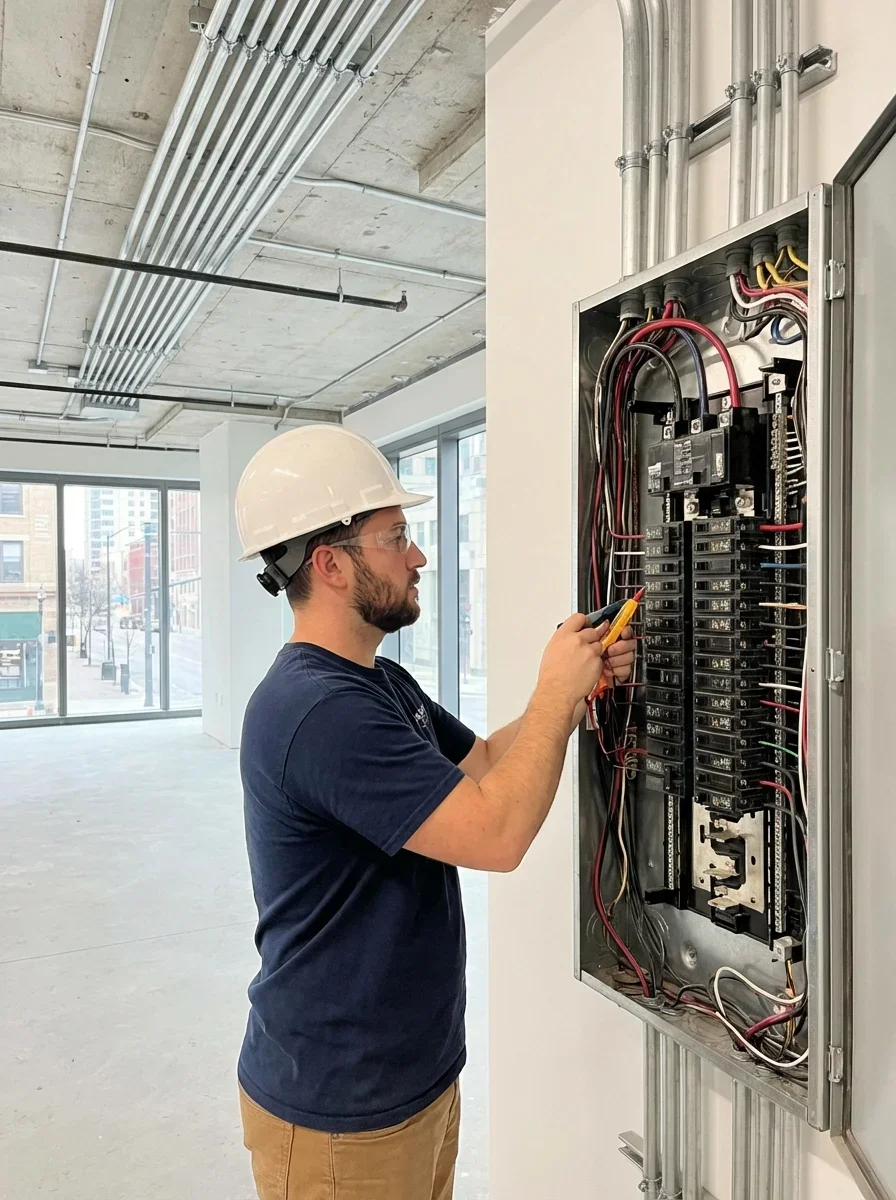
ROC requires C-11 applicants to document 4 years of practical or supervisory experience in commercial electrical work before they can sit for exams.[3] That experience must be verified by previous employers or clients. ROC scrutinizes gaps or inconsistencies in employment records during application review.
The Two-Exam Process
Applicants must pass both a Business Management exam (B) and a Trade exam (T) administered by PSI. The C-11 trade exam contains 110 questions, requires a 70% passing score, and allows 240 minutes.[4] It's open-book, meaning candidates can bring approved references including the National Electrical Code (NEC), OSHA 29 CFR 1926 standards, and manufacturer spec sheets.
Topics cover NEC chapters 1–9, grounding and bonding systems, conductor sizing and protection, raceway and box fill calculations, photovoltaic system installation, motor controls, and job site safety protocols. Phoenix's extreme UV exposure degrades wire insulation faster than humid climates. The prevalence of low-slope commercial roofs with rooftop HVAC units makes understanding Article 310 conductor ampacity derating and Article 690 solar installation critical for Arizona-specific work.
The Business Management exam tests contractor law, lien rights, contract preparation, financial management, and workers' compensation obligations. Arizona doesn't require contractors to carry workers' comp insurance, but the exam ensures licensees understand their legal exposure when they opt out.
Why the C-11/R-11 Distinction Matters in Arizona
Arizona's climate and construction methods create unique demands that inform how ROC structures classifications. Slab-on-grade construction is standard across the Phoenix metro. That means commercial electrical conduit often runs through or beneath concrete slabs poured over caliche hardpan.
Caliche's calcium carbonate content accelerates corrosion of metallic conduit. Arizona's hard water (averaging 300+ ppm calcium carbonate statewide) compounds that issue when groundwater contacts underground electrical enclosures.
C-11 contractors working in commercial properties with pool equipment, irrigation controllers, or rooftop HVAC units must account for thermal cycling that exceeds residential conditions. A black membrane roof in Phoenix hits 180°F in July, and conductor ampacity inside rooftop junction boxes drops significantly when ambient temperature exceeds NEC's 86°F baseline. R-11 residential contractors may never encounter those conditions in single-family work, which is why the classifications remain separate even though both address electrical systems under 600 volts.
Arizona Climate Warning: Rooftop junction boxes in Phoenix can reach 180°F in summer months, significantly reducing conductor ampacity ratings. C-11 contractors must apply NEC derating factors that residential contractors may never encounter, making proper license classification critical for safety and code compliance.
How to Verify a C-11 License Online
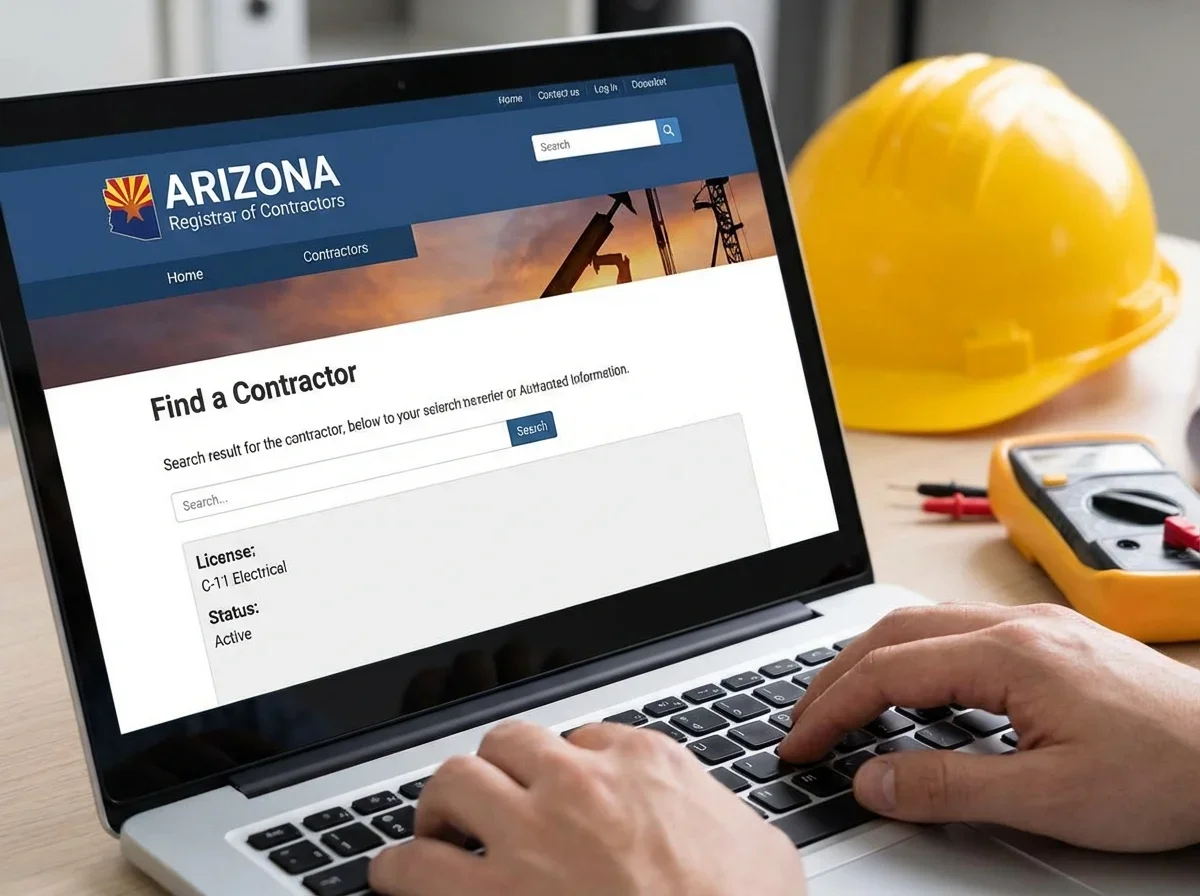
Start at roc.az.gov/find-a-contractor and enter the contractor's business name or license number. The ROC database shows:
- License status (active, expired, suspended, revoked)
- Classification codes (C-11, along with any additional licenses)
- Bonding and insurance status
- Qualifying party name (the individual whose experience and exam scores qualified the license)
- Complaint history and disciplinary actions
Arizona's ROC bond requirement ranges from $4,000 to $15,000 depending on the contractor's gross annual volume, but that bond may not cover the full cost of a major project failure. Verify the contractor carries commercial general liability insurance with limits appropriate to your project scope.
$1 million per occurrence is standard for mid-sized commercial work.
Red Flags During Verification
If the license status shows "expired" or the qualifying party listed no longer works for the company, the license is invalid even if the business is still operating. ROC's database updates nightly, so a license that was active yesterday may not be today. Check within 48 hours of contract signing.
Suspended or revoked status appears when ROC has substantiated complaints involving financial mismanagement, abandonment, or safety violations. Read the disciplinary action details. A suspension for late license renewal is different than revocation for fraudulent financial statements.
You can also verify the contractor hasn't been cited by the Arizona Division of Occupational Safety and Health (ADOSH) for serious safety violations by checking their inspection history on ADOSH's public records portal.
When Commercial Projects Require C-11 Specifically
Any electrical work in a commercial building exceeding $1,000 in contract value requires a licensed contractor under Arizona law.[3] That includes tenant improvements, parking lot lighting upgrades, commercial panel upgrades, and fire alarm system wiring.
Mixed-Use and Multi-Family Buildings
Buildings with more than two dwelling units fall under commercial classifications regardless of occupancy type. A four-unit apartment building requires a C-11 contractor, not R-11. Mixed-use properties (retail on the ground floor and residential condos above, for example) typically require C-11 for all electrical work because the structure as a whole is commercial.
Restaurant kitchens, medical suites with diagnostic imaging equipment, and auto repair shops with welding bays all require load calculations and electrical designs that C-11 contractors encounter regularly but R-11 residential contractors may not. A 200-amp three-phase panel feeding a commercial kitchen's hood suppression system and cooking equipment lineup isn't equivalent to a 200-amp residential service panel, even though both nominally handle "200 amps."
| Project Type | License Required | Typical Scope | Insurance Minimum |
|---|---|---|---|
| Single-family home | R-11 Residential | Service panels, circuits, lighting | $300K–$500K |
| 4-unit apartment | C-11 Commercial | Multi-meter installations, common area systems | $1M–$2M |
| Retail store | C-11 Commercial | Three-phase power, high-bay lighting, signage | $1M–$2M |
| Mixed-use building | C-11 Commercial | Complex load calculations, emergency systems | $2M+ |
What the C-11 License Doesn't Tell You
License classification confirms minimum legal competency. It doesn't tell you whether a contractor has experience with your specific project type.
A C-11 contractor who primarily wires warehouse shell spaces may lack familiarity with healthcare facility electrical codes (NEC Article 517) or the complexities of integrating commercial electrical systems with building automation networks.
Ask prospective contractors for project references similar to yours in scope, budget, and occupancy type. A strip mall tenant improvement is fundamentally different than a ground-up office building, even though both fall under C-11 scope. Request photos or site visit opportunities for recent work. In Phoenix's competitive commercial market, contractors with strong track records will readily provide documentation.
Bonding Limitations and Financial Protection
The ROC bond is a recovery fund of last resort, not primary project insurance. If a C-11 contractor abandons your $150,000 electrical installation midway through, the bond may only cover a fraction of your loss after ROC processes your claim.
Protect yourself by requiring payment and performance bonds for projects over $50,000, paid through a separate surety company. Those bonds guarantee project completion or financial compensation if the contractor defaults.
How C-11 Licensure Affects Permit and Inspection Processes
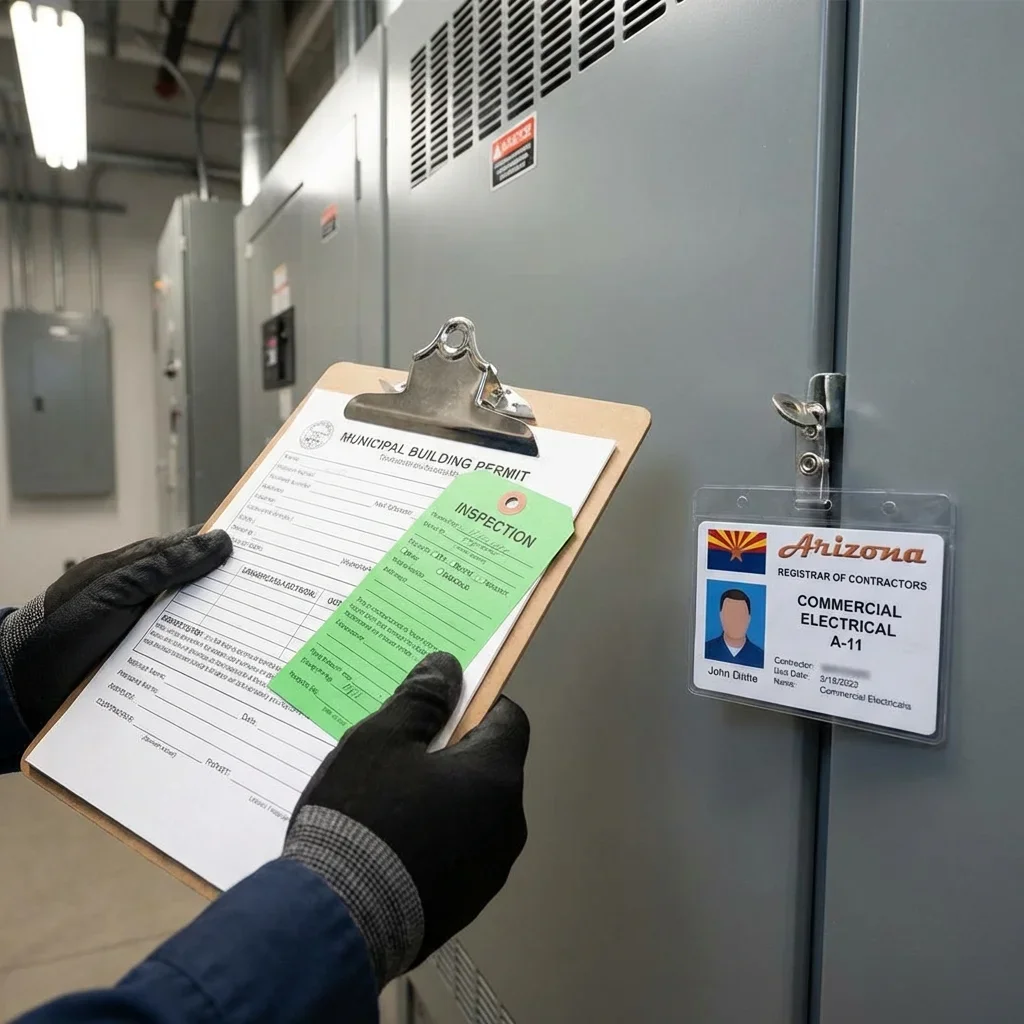
Most Arizona municipalities require electrical permits for commercial work, and only a properly licensed C-11 contractor can pull those permits. Unlicensed individuals or contractors with lapsed licenses cannot legally obtain permits, which means the work proceeds without inspection and code compliance verification.
Building inspectors verify license status before approving rough-in or final inspections. If your contractor's license expired between permit issuance and rough-in inspection, the inspector will red-tag the project until a properly licensed contractor assumes responsibility. That creates delays and complicates contractor payment terms, especially if you've already paid for work that can't be inspected.
Phoenix, Scottsdale, Tempe, and other Valley municipalities cross-reference ROC license numbers on permit applications against the state database in real time. Some jurisdictions require contractors to provide updated insurance certificates at each inspection phase, not just at permit application. Verify your contractor's policies won't lapse mid-project, especially on installations spanning multiple months.
When to Request Additional Credentials Beyond C-11
Certain commercial electrical specialties require certifications beyond basic C-11 licensure. Solar photovoltaic system installations should involve contractors with NABCEP certification in addition to their C-11 license. EV charger installations for commercial fleet charging require familiarity with NEC Article 625 and often demand coordination with utility companies for demand response programs and load management systems that residential contractors never encounter.
If your project involves emergency power systems, generators, or automatic transfer switches, confirm the contractor has experience with NEC Article 700 (emergency systems) or Article 701 (legally required standby systems). Arizona's monsoon season (typically July through September) creates sudden power outages from lightning strikes and windborne debris. Backup power is critical for medical facilities, data centers, and refrigerated storage.
Contractors performing commercial panel upgrades on buildings with existing aluminum wiring should document specific training in COPALUM or AlumiConn connection methods. Aluminum wiring was common in commercial construction during the 1960s–1970s. Improper terminations create fire hazards that standard C-11 training may not adequately address.
Finding C-11 Contractors for Your Arizona Project
Start with ROC's contractor search at roc.az.gov, filtering by license classification and geographic area. You can sort results by complaint ratio (the number of complaints per year of operation) to identify contractors with clean disciplinary records. Zero complaints over a 10-year operating history is a strong signal, though newer contractors may simply lack sufficient history.
Request quotes from at least three C-11-licensed contractors. Compare not just pricing, but project timelines, material specifications (manufacturer and product lines), warranty terms, and payment schedules.
A contractor demanding 50% down payment before pulling permits is a red flag. Standard terms run 10–20% down, 30–40% at rough-in approval, 40–50% at final inspection, and 10% retention released 30 days post-completion to cover any warranty callbacks.
Verify whether the contractor will self-perform the work or subcontract portions to other companies. If significant subcontracting is planned, request the sub-contractors' ROC license numbers and verify their classifications and complaint histories independently. The general contractor remains legally responsible for subcontractor work quality, but knowing who's on site helps you assess project risk.
How ROC Enforces C-11 License Compliance
ROC investigates complaints filed by property owners, subcontractors, material suppliers, and building inspectors. Common violations include working outside license classification, financial misrepresentation, abandonment, and unlicensed contracting. Penalties range from civil fines ($500–$2,000 per violation) to license suspension or revocation for serious or repeated violations.
If you discover a contractor is working under an expired or suspended C-11 license, file a complaint through ROC's online portal within Arizona's four-year statute of limitations. Document the violation with photos, contracts, payment records, and permit documentation. ROC typically resolves complaints within 90–120 days, though complex cases involving financial disputes may extend longer.
Property owners can also pursue civil remedies through Arizona's Registrar of Contractors Recovery Fund, capped at $30,000 per claim or the bond amount, whichever is less. The fund pays only after you've obtained a civil judgment against the contractor and demonstrated the contractor cannot satisfy that judgment.
That process can take 12–18 months from initial complaint to fund disbursement. Verify license status before signing a contract.
- Arizona Registrar of Contractors. "License Classifications." https://roc.az.gov/license-classifications. Accessed April 07, 2026.
- Arizona Registrar of Contractors. "Electrical Contractor License Classifications." https://roc.az.gov/sites/default/files/2023-05/Electrical_0.pdf. Accessed April 07, 2026.
- Arizona Registrar of Contractors. "Arizona Contractor License Information." https://roc.az.gov/contractor-information. Accessed April 07, 2026.
- PSI (for Arizona Registrar of Contractors). "PSI Candidate Information Bulletin - Arizona C-11 Commercial Electrical." https://proctor2.psionline.com/programs/AZ%20CO/C-11.pdf. Accessed April 07, 2026.
- Arizona Registrar of Contractors. "License Classification Requirements." https://roc.az.gov/license-classification-requirements. Accessed April 07, 2026.