Why License Verification Matters in Arizona
The ROC bond required for electrical contractors ranges from $4,000 to $15,000 depending on license classification. That bond doesn't cover much if a $30,000 pool electrical installation goes sideways or a whole house rewiring project damages your home.
The bond exists to fund disciplinary actions and small consumer claims, not to make you whole after major failures.
License verification gives you more than bond confirmation. You'll see whether the contractor is classified for the type of work you need—residential R-11 licenses don't cover commercial projects, and C-11 commercial licenses don't automatically include residential authority.[2] You'll spot expired licenses, current suspensions, and whether the person quoting your job is actually the licensed qualifier on file.
In Arizona, the qualifying party is the person who passed the contractor exam and holds legal responsibility for all work performed under that license. If your sales rep isn't that person, you need to meet the actual qualifier before signing anything.
Arizona also doesn't require contractors to carry workers' compensation insurance. If an unlicensed worker falls off a ladder during your exterior outlet installation, you could be liable for medical costs.
Verifying the license is step one. Asking for proof of general liability and workers' comp is step two.
The Three Arizona Electrical License Classifications
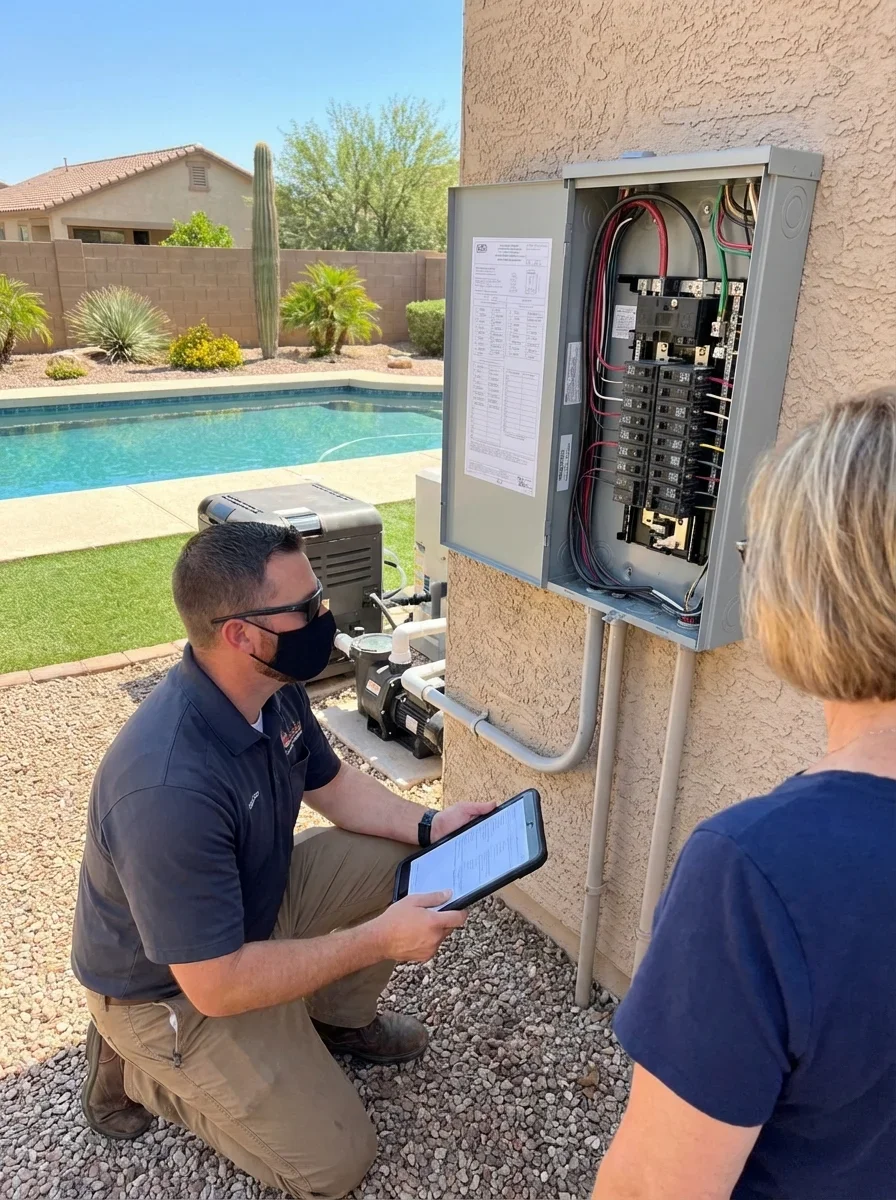
Arizona issues three electrical contractor license types, each tied to specific work scopes.
R-11: Residential Electrical
The R-11 license covers electrical work on single-family homes, duplexes, townhomes, and condos. An R-11 contractor can handle everything from panel upgrades and EV charger installations to whole house rewiring and smart home wiring, as long as the property is residential.
They cannot bid on or perform work at commercial properties, apartment complexes, or multi-tenant buildings.
C-11: Commercial Electrical
C-11 licenses authorize commercial electrical work—office buildings, retail spaces, industrial facilities, and multi-family projects over three units. These contractors can install commercial panel upgrades, parking lot lighting, and fire alarm wiring in commercial settings.
A C-11 license does not automatically cover residential work. If you're a homeowner, a C-11-only contractor shouldn't be quoting your kitchen remodel.
CR-11: Dual Classification (Residential and Commercial)
The CR-11 is a combined license allowing contractors to work on both residential and commercial projects.[2] This classification is common among larger firms that serve both markets. You'll often see CR-11 licenses held by electricians who do residential service calls during slow commercial seasons and vice versa.
The license type listed on the ROC website tells you whether the contractor is legally allowed to do your job. A homeowner hiring a C-11 contractor for residential work (or a business hiring an R-11 contractor for a commercial project) creates liability exposure for both parties. The work won't be covered by the contractor's bond, and your insurance may not cover damages.
| License Type | Authorized Work Scope | Bond Requirement | Typical Projects |
|---|---|---|---|
| R-11 | Residential only (single-family, duplexes, condos) | $4,000-$7,000 | Panel upgrades, home rewiring, EV chargers |
| C-11 | Commercial only (offices, retail, industrial, 4+ units) | $7,000-$15,000 | Commercial lighting, fire alarms, multi-unit buildings |
| CR-11 | Both residential and commercial | $7,000-$15,000 | Full-service electrical for all property types |
How to Use the ROC License Search Tool
Go to https://roc.az.gov/license-search to access the official lookup tool.[1] No login required.
You can search by contractor name, business name, or license number. If you have the license number from a business card or estimate, use that. If you only have a name, expect multiple results. Arizona has dozens of contractors named "John Smith Electric." Narrow results by matching the business name and city.
What the License Record Shows
Each active license displays:
- License number and classification (R-11, C-11, or CR-11)
- Qualifying party name (the individual who passed the exam and holds legal responsibility)
- Business name and DBA (doing business as) if applicable
- Expiration date (licenses renew every two years; an expired license means the contractor cannot legally work)
- Bond status and amount (confirms the surety bond is active)
- Active or inactive status ("inactive" means the license isn't valid for new contracts)
If the record shows "license not found," the contractor is either unlicensed or gave you a fake number.
Either way, walk away.
The lookup tool also displays complaint history and disciplinary actions. You'll see formal complaints filed with the ROC, whether the complaint was substantiated, and any resulting fines, suspensions, or license restrictions. A single complaint over a billing dispute doesn't necessarily disqualify a contractor. A pattern of unresolved complaints about shoddy work, unpermitted installations, or abandoned jobs should.
Checking Bond and Insurance Status
The ROC bond is listed directly in the license record. You'll see the bond amount and whether it's active. If it says "bond expired" or "no bond on file," the contractor is operating illegally.[3]
The ROC database does not verify general liability or workers' compensation insurance. Those policies are separate. Ask the contractor for certificates of insurance (COIs) naming you as an additional insured, and call the insurance company listed on the certificate to confirm the policy is active.
Contractors can print expired or fraudulent COIs. A two-minute phone call to the insurer prevents future headaches.
In Phoenix, where summer temperatures push electrical panels, breakers, and wiring to their thermal limits, insurance claims for electrical fires and equipment failures spike June through August. The contractor's general liability policy is what covers property damage if a faulty surge protection installation or panel upgrade causes a fire. No active policy means you're self-insuring their mistakes.
Verifying the Qualifying Party and Job-Site Workers
The qualifying party listed on the ROC license is the only person legally authorized to pull permits and supervise work under that license number. If your estimate comes from a salesperson, project manager, or site foreman, ask to speak with the qualifier before signing.
You need to confirm the qualifier will oversee your project and that they're aware of the scope, timeline, and quote.
Arizona law allows licensed contractors to employ unlicensed workers, apprentices, and journeymen under their supervision. What's not legal is an unlicensed individual operating under someone else's license without that person's knowledge or involvement. It happens more often than ROC enforcement can track. You verify the qualifier's involvement by asking for their contact information and checking the ROC record to match the name.
If the qualifying party on the license is "John Doe," but your contract is with "Desert Electric LLC" and no one named John Doe ever shows up, you're dealing with a shell license. That setup leaves you with no recourse if the work fails inspection or the crew disappears mid-job.
What Complaint History Tells You
The ROC complaint database shows formal complaints filed by homeowners, other contractors, and municipal inspectors. Each entry includes the complaint date, a brief description, the investigation outcome, and any disciplinary action taken.
Green flags:
- No complaints in the past two years
- Complaints marked "resolved" or "dismissed" with explanations
- Licensing violations corrected promptly with no repeat issues
Yellow flags:
- One or two complaints about scheduling delays or minor code issues, but all resolved
- Complaints filed but later withdrawn after the contractor corrected the problem
Red flags:
- Multiple complaints about the same issue (e.g., unpermitted work, unfinished jobs)
- Complaints marked "substantiated" with fines or license suspensions
- Pattern of complaints about unlicensed workers or misrepresenting qualifications
- Failure to respond to ROC investigation requests
A contractor with five substantiated complaints in three years isn't someone you want installing a $8,000 whole house generator or rewiring your 1985 Phoenix home with aging copper lines and caliche-blocked conduit runs.
The ROC publishes this data for a reason. Use it.
Quick Verification Checklist:
- Search contractor license at roc.az.gov/license-search
- Confirm license type matches your project (R-11/C-11/CR-11)
- Verify qualifying party name and ensure they'll oversee your job
- Check bond status shows "active" with correct amount
- Review complaint history for patterns of substantiated issues
- Request certificates of insurance (COI) for liability and workers' comp
- Call insurance company to verify COI is current
- Confirm permits will be pulled before work starts
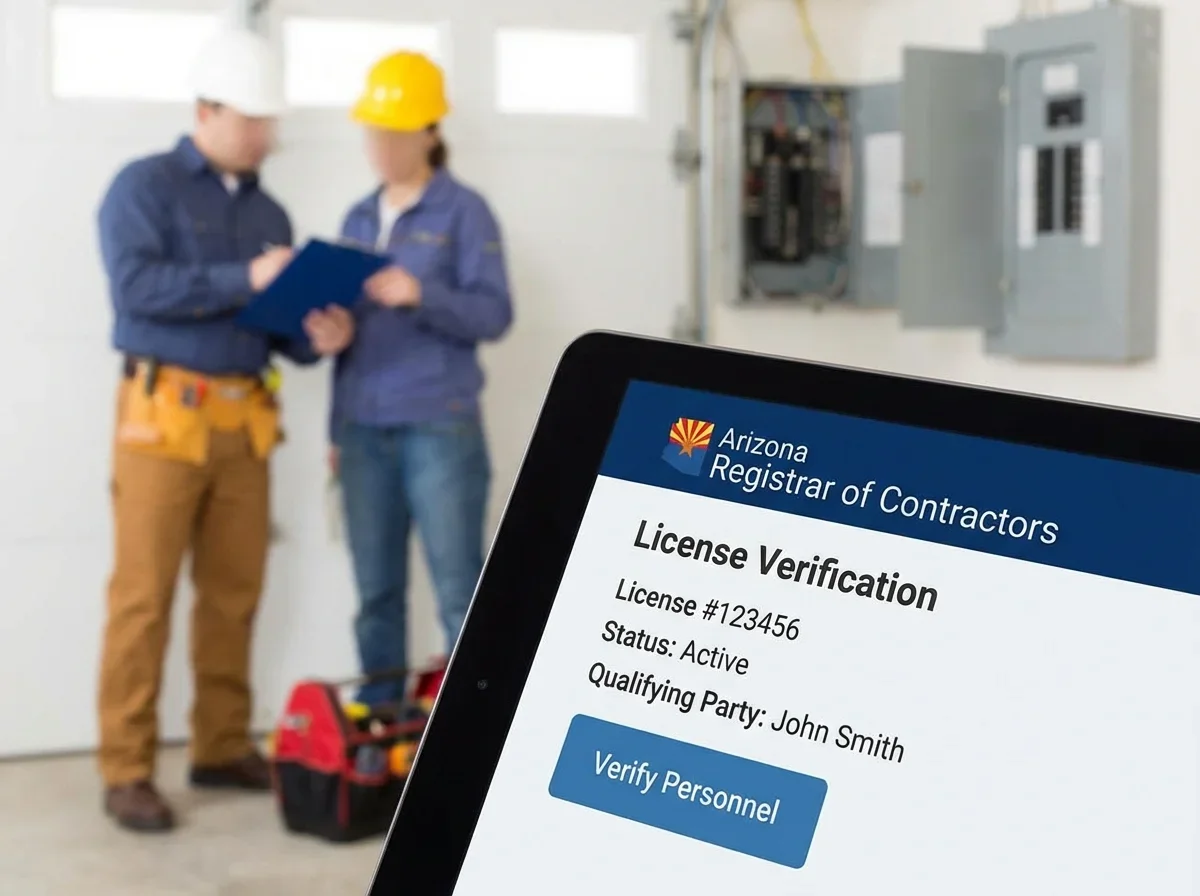
How to Verify a License by Phone
If you can't access the online database, call the ROC Licensing Department at (602) 542-1525 during business hours.[4] Have the contractor's license number or business name ready. The representative will confirm active status, license classification, bond status, and whether any open complaints or suspensions exist.
Phone verification is slower than the online tool, but it gives you a contact person if you have questions the database doesn't answer. For example: "This contractor has an R-11 license, but they're quoting a four-unit apartment complex. Can they do that?" The answer is no, and the ROC rep will tell you that.
The online database won't.
Verifying Permits Before Work Starts
An active ROC license doesn't mean the contractor will pull permits. Arizona law requires permits for most electrical work, including panel upgrades, circuit installations, and EV charger hookups.[5]
Unpermitted work can void your homeowners insurance, complicate future sales, and result in fines during municipal inspections.
Before the contractor starts, ask for the permit number. Most cities and counties in Arizona publish permit records online. In Phoenix, you can search permits at phoenix.gov/pdd. In Mesa, Tempe, Scottsdale, and Chandler, check the city's development services portal. If the contractor says "we'll pull it later" or "this job doesn't need one," verify that independently with your city's building department.
Unpermitted work is one of the most common complaints filed with the ROC. Contractors skip permits to save time, avoid inspection scrutiny, or hide substandard installations. If your aluminum wiring replacement or kitchen remodel electrical work isn't permitted and inspected, you have no third-party confirmation it meets National Electrical Code (NEC) or Arizona amendments.
That's a problem when you sell the house or file an insurance claim after a fire.
Red Flags That Mean You Should Walk Away
Even if the ROC license checks out, watch for these warning signs during the hiring process:
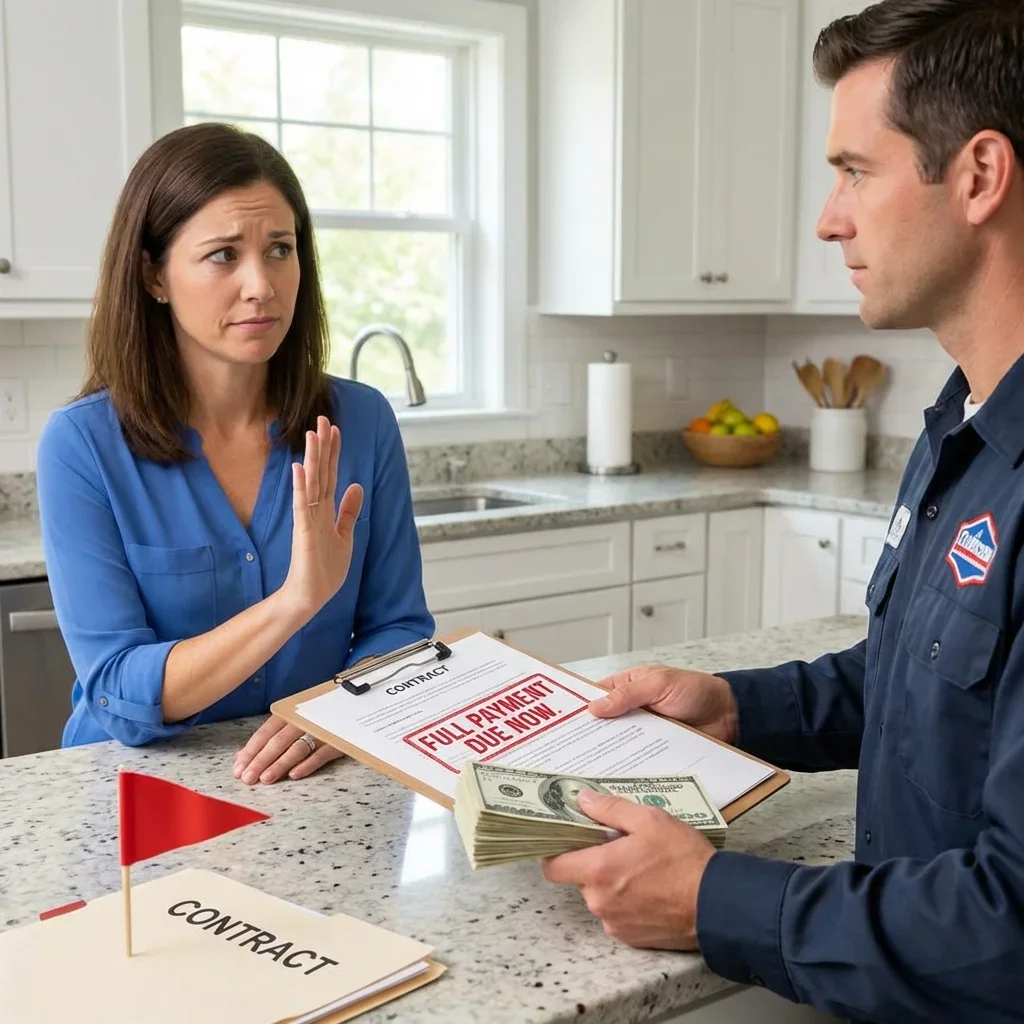
Pressure to pay in full upfront. Licensed contractors typically ask for a deposit (30-50%), then invoice progress payments as work completes. Demanding 100% before breaking ground is a classic setup for abandonment.
No written contract. Arizona law doesn't require written contracts for jobs under $1,000, but any reputable contractor will provide one. The contract should list the license number, scope of work, timeline, payment schedule, and warranty terms.
Unwillingness to provide insurance certificates. If the contractor refuses to email COIs or says "we're insured, don't worry about it," they're either uninsured or underinsured.
Vague answers about the qualifying party. You ask who the qualifier is, and the sales rep says "I'm not sure, but we're fully licensed." That means they're operating under someone else's license without proper oversight.
Quoting work outside their license scope. An R-11 contractor offering to install commercial electrical systems or a C-11 contractor bidding residential jobs is either ignorant of licensing rules or deliberately flouting them.
These red flags don't always mean the contractor is unlicensed. They do mean you're not getting the professionalism and accountability an ROC license is supposed to guarantee.
Pro Tip: Arizona's extreme heat accelerates electrical component degradation. A contractor cutting corners on permits or using undersized wire in your attic (where temperatures hit 150°F in summer) creates fire risks that won't show up until the damage is done. License verification and permit compliance aren't bureaucratic hurdles—they're your protection against catastrophic failure.
What to Do If You Hired an Unlicensed Contractor
If you discover mid-project that your contractor's license is expired, suspended, or fraudulent, stop work immediately. Do not make additional payments.
Arizona law makes it illegal for unlicensed contractors to file liens or sue for payment on work performed without a valid license.[5]
Contact the ROC to file a complaint at roc.az.gov/contact-us or by calling (602) 542-1525.[4] The ROC's Residential Contractors' Recovery Fund may reimburse you up to $30,000 if you can prove the contractor violated Arizona contracting laws and you suffered financial loss. You'll need documentation (contracts, invoices, photos of defective work, and proof you attempted to resolve the issue with the contractor first).
If the contractor abandoned the job or left dangerous conditions (exposed wiring, open electrical panels, half-finished recessed lighting installations), hire a licensed electrician to make the site safe and complete the work. Save all invoices. You'll need them to quantify damages if you pursue recovery through the ROC or small claims court.
Unlicensed electrical work creates serious safety risks. Arizona's high temperatures and hard water accelerate corrosion in substandard wiring and connections. Improperly installed circuits in Phoenix's slab-on-grade homes (where all electrical runs are buried in or under concrete) can overheat, arc, and start fires invisible until smoke fills the room.
Don't let sunk costs tempt you to overlook licensing violations.
How to Use the ROC Database for Ongoing Projects
License verification isn't a one-time step. If your project spans weeks or months (think whole house rewiring or a landscape lighting installation), check the license again mid-project.
Contractors occasionally let bonds lapse or fail to renew licenses on time. If the license expires while your job is active, work must stop until renewal completes.
You can also check the database after work finishes to confirm the contractor maintains their license and clean record. If they rack up complaints in the months after your project, that's useful context if issues surface later. Arizona's dry heat and desert UV degrade electrical insulation faster than humid climates. Problems with poorly executed surge protection or sub panel installations may not appear for six months.
If the contractor's license is suspended when those issues emerge, recovery becomes harder.
Verifying Electrical Inspections and Final Sign-Off
After work completes, verify the city or county issued a final inspection approval. In Phoenix, Mesa, Chandler, Gilbert, Scottsdale, Tempe, Glendale, Surprise, and Buckeye, municipal inspectors review permitted electrical work to confirm NEC compliance and safety standards.
Request a copy of the signed inspection card or certificate from your contractor. If they say the inspection passed but can't produce documentation, call the city's inspection department and verify using your permit number.
Passed inspections close the permit and create a public record that future buyers, appraisers, and insurance adjusters can reference.
Failed inspections require correction work and re-inspection. If your contractor ghosts you after a failed inspection, you'll need to hire another licensed electrician to fix the deficiencies and schedule re-inspection. That's why verifying the license, bond, insurance, and complaint history upfront matters.
Fly-by-night operators don't stick around to fix failed inspections. Established, licensed contractors do.
- Arizona Registrar of Contractors. "License Search." https://roc.az.gov/license-search. Accessed April 06, 2026.
- Arizona Registrar of Contractors. "Electrical Contractor Classifications." https://roc.az.gov/electrical-contractor-classifications. Accessed April 06, 2026.
- Arizona Registrar of Contractors. "Verify a License." https://azroc.gov/verify-license. Accessed April 06, 2026.
- Arizona Registrar of Contractors. "Contact Us." https://roc.az.gov/contact-us. Accessed April 06, 2026.
- Arizona State Legislature. "Contractor License Information." https://www.azleg.gov/ars/32/01121.htm. Accessed April 06, 2026.